Friday, October 24, 2014

Nomenclature of Fowls

Nomenclature of Fowls. c. February 1855.

The principle on which poultry nomenclature is founded is mainly that of their original geographical dispersion. In several classes this is sufficiently authenticated ; but in others from the little attention, in former days, bestowed upon the subject, and the difficulty of recognizing present rates in the usually vague and indistinct accounts of the few early writers on this branch of natural history, great uncertainty necessarily prevails.

Malays, and other Asiatic fowls, Bantams and Shanghaes. we are enabled to trace satisfactorily from their primitive habits; hence, indeed, our often expressed unwillingness to accept erroneous designation of "Cochin-China," a district from which few, if any, specimens of the last named fowls appear to have been derived, while Shanghae {Shanghai}  is clearly the head quarters of the breed.

The same reasoning sanctions the employment of the term Dorking to the five-clawed fowls that had their origin in the districts around that town, or were at least, those first brought into general reputation.

Hamburghs, again, in the " Pancilled " variety, are fairly referable to that locality, though far, we must acknowledge, from being so exclusively ; more especially in recent years, when our main supply has been received from Holland, The "Spangled" Hamburghs however, are justified in claiming that title solely from certain features common to them with the pencilled birds.

But, at the same time, the various synonyms that are suggested in lieu of their present generally received designation, are all and each of them, open to equal, if not greater, objections than that they now bear.

 Regarded in this light, the Polish fowl has a still worse case, and the principle of an original geographical position, is here unsupported by any trustworthy evidence, if usage, therefore, be considered as insufficient authority for the name they now bear, we must confess our inability to afford any clue to a better designation founded on the same ground. So that, if we depart from the present system, to style them simply  " tufted fowls," seems the only alternative left to us.

Game fowls were emphatically called, by no less an authority than Buffon, the celebrated French naturalist, the English fowl, and, indeed, if an uniform geographical system be insisted on. we do not see how they could be better described, although the derivation would here proceed from the circumstance of their having been brought to the highest state of perfection, not from having been the aboriginal fowl in this country.

 Lastly, as respects Spanish, the type of that breed is pre-eminent in Spain, though common in a greater or less degree, throughout various regions on the shore of the Mediterranean Sea. The various alleged distinct breeds that make appearance in the "miscellaneous" class, may, for the present, be omitted in the inquiry now before us. Those already mentioned are, confessedly, the great divisions of the species; and if we are not mistaken, the remainder, Silk fowls, and one or two others, at the utmost, alone excepted, it will be difficult to make out their claim to any distinct and separate origin.

Polish and the Spangled Hamburghs are, therefore, the cases where the principle of geographical disposition fails to warrant the names of our fowls. Many and labored have been the efforts to assign the primitive abode of the former; but, however plausible and ingenious, none have hitherto carried conviction to our own mind ; and a majority of those who hare turned their thoughts to the same subject are probably of the like opinion. But the main object of any name applied to any object, animate or inanimate, is to specify and distinguish it from others; if, indeed, the name so given has a manifest tendency to mislead to important erroneous conclusions, a grave objection is at once evident, and proof of a more accurate designation should at once cause the disuse of the misnomer.

But as before stated, unless we substitute "tufted fowls " for Polish, and, perhaps. " rose-combed, spangled fowls," for the present Spangled Hamburghs, we see no solution for our difficulty ; and if this be done, geographical disposition ceases to be our guide.

An accurate designation of a species, either animate or inanimate, has frequently been unattainable till after many changes and revisions.

 Botany, and other sciences, afford us many instances of such alterations; we need not, therefore, be surprised if the "nomenclature of fowls," a subject on which general attention has only so recently been bestowed, should as yet labor under the same difficulty. Efforts, however have been made of late to reduce the previously confused and contradictory system to some degree of order, and the assent of an over whelming majority of Poultry Societies, has been accorded to the classification promulgated at Birmingham.

Nor do we see how any better example could have been followed. Our decided impression, from all that has been advanced on the subject, points to the retention of the present system, founded on geographical disposition as the basis for the nomenclature of fowls; some modifications, it is true, may be desirable, and in certain cases, the evidence may not be altogether satisfactory as to the original locality.

We look around,'however, in vain for any other better principles of classification, and, furthermore, confidently anticipate that the care that is now being bestowed on the points of merit of the different breeds, will also conduce to the most correct nomenclature, for which authorities may be attainable.— London Cottage Gard.


Eggs as Cream for Coffee & Tea

from our friend, the California Farmer


Substitute for Cream, in Tea or Coffee. Beat the white of an egg to a froth, put to it a very small lump of butter, and mix well. Then turn the coffee to it gradually, so that it may not curdle. Properly done, it will be an excellent substitute for cream.


 For tea, omit the butter, using only the egg. This might be of great use at sea, as eggs can be preserved fresh in various ways.

Quinoa Tabbouleh Kosher Style

Lebanese Tabbouleh from Denis Phillips, The Gourmet Jewish Cookbook.

This recipe is  PAREVE    DIABETIC FRIENDLY    DAIRY-FREE    SUCCOT &   SHABBAT approved.

What that means is it is "Kosher" or fit or proper to eat.  The word kosher is  derived from the Hebrew word ‘Kashrut’, or the body of Jewish law which deals with what Jews can and can’t eat, and how to prepare and eat what is allowed.

The origins of the rules of Kashrut are found in the Torah, the first five books of the Jewish Bible, The Old Testament.

 The reasons for these rules are not given and for thousands of years Jews have debated ‘why keep kosher?’ Possible explanations include health benefits, environmental considerations, to reach holiness through self-control, to practise religious ritual and to be separate from other groups. The debate is ongoing – the short answer most Jews accept is simply because the Torah says so. For an observant Jew no further reason is needed.


There are three categories of kosher food:
Meat
Only animals which have split hooves and chew the cud are permitted. Cows and sheep are fine – pigs, horses and rabbits are not. Kosher poultry includes chicken, turkey, geese and duck. Animals which can be consumed are ritually slaughtered and no blood can be eaten.

Dairy
Dairy products from kosher animals are allowed. However, these cannot be mixed with meat or poultry in the same recipe, at the same meal or even on the same plates. So kosher households have two sets of everything to do with food preparation and delivery, from pans and plates to tea towels and dish cloths.

Parev
Foods with no meat or dairy content are called ‘parev’ and are neutral. All eggs, fruits, grains and vegetables are parev and may be served with meat or milk meals.

Fish is not classified as a meat, but we are only allowed to eat fish that have fins and scales, such as tuna, salmon, cod and herring. Shellfish of any sort and other ‘scavengers’ are forbidden. Whilst fish is parev, it is not served on the same plate or within the same dish as meat – which means, for instance, that you can’t use something like Worcestershire sauce to add flavour to a beef stew, because it has anchovies in it.

Spirits and alcohol made from grains are kosher. However, there are specific guidelines for wine and wine-products such as brandy. To be kosher, wine has to be prepared from grape to bottle under Rabbinic supervision.

Nowadays a lot of our food is packaged or processed and it can be hard to know the source of the ingredients, how they have been manufactured and whether they are all kosher. To assist the modern shopper, there is a system of certification which involves the Rabbinic authorities scrutinising products made for the Jewish and non-Jewish market to ensure that all the ingredients and all the processes meet approved standards. There are various issuing authorities but one of the biggest is the KLBD.
Shabbat and Yom Tov [holiday] Cooking
Because we are not allowed to ‘work’ on Shabbat and Yom Tov,  there are strict rules in Kashrut regarding food preparation including storing,  heating and reheating foods. The general principle is to prepare in advance a selection of dishes which can either be eaten cold or kept warm for a long time.
For further guidance consult your local community Rabbi.

=====================================================

Tabbouleh is a traditional Lebanese salad made with bulgur wheat. It is said to have originated as a way of using up the random pickings of whatever was in the kitchen garden. This dish is a standard part of a cold Middle Eastern meze starter. I like to use a ratio of 5:1 parsley to mint for the perfect flavour. Use the baby gem lettuces to scoop the salad into manageable serving portions.

Almost all of what was once a thriving Mizrachi Jewish community in Lebanon has emigrated to the USA, Canada, France, Israel, Argentina, Brazil and Australia. The remaining few Lebanese Jews today live in and around Beirut and tend to keep a very low profile, understandably.

=====================================================


The Jewish Tabbouleh recipe: 

Info
• Preparation Time: 15 minutes
• Cooking Time: 10 minutes
• Serves: 6

Ingredients

  • 110g/4 oz bulgur wheat (quinoa) 
  • • 500g/1 lb tomatoes: chop half and thinly slice the rest
  • • 3 spring onions, peeled and finely chopped
  • • 20g/¾ oz mint, finely chopped
  • • 100g/4 oz parsley, finely chopped
  • • 1 tbsp sumac
  • • sea salt and black pepper, to taste


For the dressing
• zest and juice of 1 lemon        • 4 tbsp extra virgin olive oil
• 1–2 cloves garlic, peeled and finely chopped
• Garnish: 12 baby gem lettuce leaves, olives, chopped


Method
• Put the bulgur wheat in a pan of boiling water. Cover and simmer for 8–10 minutes or until just soft. Drain and cool.

• Add the tomatoes, spring onions, mint, parsley and sumac and season well
• Combine the dressing ingredients and pour over just before serving.
• Keep chilled until ready to serve.
To serve the stylish way: Place a circle of baby gem lettuce leaves around the tabbouleh. Garnish with chopped olives.

Advice on Fixing your Attention


Fixing the Attention.
What is commonly called abstraction in study. is nothing more than having the attention so completely occupied with the subject in hand, that the mind takes notice of nothing without itself. One of the greatest minds which this or any other country ever produced, has been known to be so engrossed in thinking on a particular subject, that his horse had waded through the corner of a pond; yet, though the water covered the saddle, he was wholly insensible to the cause of his being wet.

I mention this, not to recommend such an abstraction, but to show that he who has his attention fixed, and the power of fixing it when he pleases, will be successful in study. Why does the boy who has a*large sum upon his slate, scowl, and rub out, and begin again, and grow discouraged ? Because he has not learned to govern his attention. He was going on well, when some new thought floated into his mind, or some new object caught his eye, and he lost the train of calculation.

Why has the Latin or Greek word so puzzled you to remember, that you had to look it out in your dictionary ten or a dozen times? And why do you not look at it as at a stranger, whose name you ought to know, but which you cannot recall ? Because you have not yet acquired fully the power of fixing your attention. That word would have been remembered long since, if it had not passed as a shadow before your mind, when you looked at it.

A celebrated authoress, who states that she reserves all her i's to be dotted, and her t's to be crossed on some sick day, might have given a more philosophical reason; and that is that she could not bear to have her attention interrupted a single moment, when writing with the most success. — Student's Manual.

Quinoa KISIR

Serves 8 •

 Kisir is a filling and luscious Turkish country salad.

  • 1½ cups bulgur (cracked wheat)
  • 2 tablespoons tomato paste 
  • 5 tablespoons extra-virgin olive oil  (Kalamata olive oil is the best)
  • Juice of 1 lemon 
  • Salt ⅓ teaspoon chili flakes or pinch of ground chili pepper, to taste
  • 1 cup chopped flat-leaf parsley ⅓ cup chopped mint leaves
  • 6 scallions, finely chopped
  • 2 large tomatoes, finely diced

Again instead of the traditional bulgur use either Kasha (buckwheat) or Quinoa.  Greeks btw have this same dish but with Rice.  Kasha must be boiled until soft first but quinoa does not.

Directions:
  1.  Put the bulgur in a bowl, pour plenty of boiling water on it, and leave for 20—60 minutes, until the grain is tender. 
  2. Drain and squeeze the excess water out in a colander.
  3.  Add the tomato paste, oil and lemon juice, salt and chili flakes or chili pepper and mix thoroughly. You can do this in advance. 
  4. Just before serving, mix in the rest of the ingredients. 

Variation

 Add 2 tablespoons of sour-pomegranate concentrate for a sweet-and-sour tartness.
Greeks use vinegar.

also from Claudia Roden's book, The New Book of Middle Eastern Food.

Thursday, October 23, 2014

The importance of calcium for eggs


Feeding Poultry. — Professor Gregory, of Aberdeen Scotland, in a letter to a friend, observes: —
" As I suppose you keep poultry, I may tell you that it has been ascertained that if you mix with their food a sufficient quantity of eggshells or chalk, which they eat greedily, they will lay twice or thrice as many eggs as before.
" A well-fed fowl is disposed to lay a large number of eggs, but cannot do so without the materials of the shells, however nourishing in other respects her food may be; indeed, a fowl fed on food and water, free from carbonate of lime, and not finding any in the soil, or in the shape of mortar, which they often eat on the walls, would lay no eggs at all with the best will in the world."

January 11 1855, California Farmers.


While I cannot attest to anything about eating the "plaster" on the walls, I can say that I wallpapered my coop with chicken feed bags underneath which is the insulation.  They obviously smelt the insulation and tore at the bag wallpaper to get to it, not finding it to their taste they tore that out.  This year we have been fixing all those holes with a second layer of feed wallpaper, overlapping as much as possible...so far so good.

As for the lime, and the calcium that is true that hens love and need it for the production of their eggs, but surprisingly so do the cockerels and roosters.  Perhaps like Popeye they want to grow strong and have good bones.


California Pelican, c 1855


Sketches of the Natural History of California.

THE PELICAN OF CALIFORNIA.

ALEX. S. TAYLOR.


This bird, called by the Spaniards Alcatraz, is very abundant on the Pacific Coasts of North and South America. The variety inhabiting the shores of California is found from Acapulco to the Columbia river, and is migratory in its habits.


The male bird weighs between ten and twelve pounds and measures 4 3-4 feet from the beak to the end of the tail. The wings w hen stretched out, measure, including across the breast, 7 3-4 feet. One of the wings measures 3 1-3 feet, and across the breast 7 1-2 inches. From base of neck to vent 15 inches—the neck is 21 inches long. The upper mandible is 13 1-2 inches long and 1 1-4 inches broad; it shuts down mostly within the lower mandible, and has three midparallel ridges running along the roof of the mouth, two of which are grooved in their centre, and hard and sharp near to the beak.


The beak is marked black and yellow, and longitudinally corrugated; acutely curved, very sharp, hard, and slightly nicked, and is 1 3-4 inch long by 3-8 of an inch thick and broad. The lower mandible is as long as the upper, but is 2 inches broad and which can easily be stretched to 8, —to it is woven into and attached the pouch, which, by measurement of one a few weeks ago, I found to be capable of containing over five gallons of water —the lower beak is of the size of a filbert and very hard. The edges of the mandibles and of the upper beak are sharp and fine. The head is 4 1-2 inches long by 3 inches thick and broad, and shaped triangular.


The eye is surrounded with bare skin and is 5-8 of an inch ; the color of the iris in the male is of a gay, silvery steel —that of the female is of a dull pinkish brown —the ear is situated 2 inches from the eye. The bill of the male is oval, ridged, spoon shaped, and fleshed of a red color; that of the female of the same form and of a dulled white. The nasal organ is only a slit at the base of bill—the nasal groove extends to the beak—the tongue is a small grizzly elongation on the point of the triangular bone of the trachea. The skin of the pouch is of dirty lead color, entirely bare of feathers, marked with lines and extremely elastic and soft; the trachea is in the middle of it, immediately under the termination of the jaw bones. The legs are of a lead color, 8 inches in length; the palm of the foot is 6 inches long and measures 6 1-2 inches across the end of the toes, which are armed with blackish nails.


The tail of the bird has 24 feathers, is of a rounded fan shape, and 6 inches long.


The bones arc all air-celled, and very light; the skeleton weighs only 2 1-4 pounds; the wing bones of each wing, although 30 1-2 inches in length, weigh only 2 1-4 ounces. The oil sack is very large, and weighs nearly half an ounce—its covering is of long white featherets which are always charged with oil.


The plumage of the male is in color distinct from that of the female. The head of the male and upper portion of its heck is covered with long, close, plushy featherets, of a beautiful yellow color; the lower edge ot the neck at the breast has a band of the same color. Both birds have a long crest down the base of the head and along the upper part of the neck. The breast and belly of both is downy white. The wings and back of the male bird are of a white and silvery steel color intermingled in elegant stripes and mottles. The female is about one-sixth smaller and generally weighs 8 pounds.


The color of its plumage is of a dull heavy lead caste, and she is much more stupid and slow than the male. The stomach of the male is covered with a large quantity of hard, deep, orange-colored fat, within which is the gizzard, of a long oval figure; within the mass of fat, (which weighs one and a half pounds,) the gut is found in long convolutions intermingled throughout its substance. This is entirely wanting in the female so far as I have seen ; both being examined at the same time and season.


The meat of the male is brownish red, and of a much finer texture than that of the other, and is more abundant in quantity, The primary wing feathers of both are about 18 inches long and of a dull black—the breadth of wing is 10 inches. The general features of both birds are alike except the color of the plumage and mandibles—the bill is straight, and is flattened near the beak. Tho skin of the bird is covered with a mass of flocculent cells highly air-charged. None of the figures or descriptions of this Pelican, as delineated in Whitelaw's Goldsmith of 1840—Milne Edwards of Paris 1834— Carpenter's Zoology of 1844—nor Carpenters Cuvier of London 1849, agree with the particular features, when closely observed, of the California variety of this bird.


The figure in Carpenter's Zoology, pp. 521, vol. 1, is nearly like the bird we attempt to describe. These authors all confound the sea with the land Pelican,


The egg of our pelican is of alight green color, marked with blackish brown splotches, and its surface is roughened and not polished like that of the eggs of ordinary land birds. The substance of the egg is encased in a tough calcareous pellicle nearly as thick as a fowl's eggshell.


The albumen of the egg when boiled is of a transparent milky color. The size of the egg is three and a half inches in length, and two inches in diameter —it is long in figure and sharply peaked, measuring only one-fourth of an inch at the apex; it weighs nearly three ounces. Great numbers of these eggs arc brought to the market of San Francisco from the Farralones islands and the neighboring rocks and islets of that part of our coast, and form an important article of food: many persons prefer them to fowl's eggs. In January, 1852, a sloop of 25 tons, loaded with bird's eggs from the Farralones, was cast ashore on Monterey beach.


The Pelican of our coasts lays its eggs and hatches its young on all the solitary islands and rocky islets from the Gulf and Ocean shores of Lower California up to Vancouver Island, as I am informed by old sailors. It lays from four to six of a season, beginning to hatch and bring forth their young in March and April—the young are able to fly in September of the same year.


The California Pelican is said to be found on the Pacific Coasts from Valdivia in Chili, to Vancouver Island. There is a smaller variety of the species found on the same southern coasts, and those of the Gallipagos Islands (where they are very numerous) which arc also said to be similar in color to ours, though one quarter smaller in size. An old whaler informs me that on the shores of Behring Straits and the N. W. Arctic, a variety of white Pelican, the size of a common duck, is found in great numbers. It will be seen that the Ocean Pelican of California is very different from that of the Great White Pelican of the Lagoons of the Salinas, Sacramento, and Tulare valleys of out State.


This bird, which we have not yet seen, is stated to us by old settlers and hunters, to be nearly double the size of the Sea Pelican when standing —it is entirely white except the ends of the outer wing feathers which are black. This Pelican never visits or feeds on the sea coasts, The California Pelican begins to arrive in the Bay of Monterey about the first of September, following the schools of innumerable sardines, herring and mackerel which visit us then —and leave about the first of February.


The pursuit of their prey is the most lively and sprightly habit of the bird. During this period they abound in great numbers, chasing the fish with great pertinacity and greediness in fellowship with the most astonishing companies of all kind of our sea fowl. In a clear day when the small fish are plentiful, they may be seen close to the shore in numbers of fifty and a hundred, circling with flocks of gulls at an elevation of twenty to thirty yards above the sea.


This appears to be done with a view of scaring the fish into a close body, (or as the Spanish say, corraling them,) when the Pelican descends with the velocity of a shot ka-plunck into the water, scooping up into its extended lower mandible and pouch the stunned and frightened small fry; when they rebound like a cork to the surface. The sight of twenty and thirty of these huge birds falling at once like a living cataract, from the air, and splashing the water into spraying fountains, with the shrieks and quarrels of the gulls and shags snatching the fish from the bigger birds, is as curious, as it is striking and novel, and forms one of the most animated features in the fall months of the beautiful Bay of Monterey.


They often continue this manoeuvre from " night to morn and morn till dewy eve," keeping up such an infernal clatter and racket, with the bleatings and barkings of sea lions and others, intent on the same errand, as to persuade a stranger in these parts, that old ocean was giving up its forgotten dead of a thoussand years. As the Pelican desends it gives its body a quick spiral movement, and plunges its whole body under the water, with its wings close shut to its sides. When it rises buoyant from the sea it uses its wings as paddles, and flaps its webbed feet on the water by springs for over fifty feet, before it can sail away into the air.


Towards evening they may be seen in straight regimental lines of ten and fifteen, one following close behind the other, leisurely and solemnly wending their way to their rocky or sandy barracks hard by the ocean shore, In the fall of 1852, the Pelican arrived in our bay in numbers incredible. In the afternoon and night they could always be found on our first lagoon, sitting lazily on the ground, or perched on the trees overhanging the water, sleeping or dozing with the bills and heads under the wings. When on land it can be easily approached, and is a stupid, lazy, dirty creature, and generally full of whacking bird-lice. It is a heavy melancholy looking animal, with the eyes and leer of an ogre.


When gorged they can bo easily approached and killed with a stick: their only weapons are their wings and beaks, and it is rather unpleasant when you get your fingers shut down upon by its scissors-like mandibles. The Indians of Tobasco, Campcachy, and Yucatan, are said by the old Jesuit Fathers, to train these birds so well, as to catch fish for their owners, like the Cormorants of the Chinese. The Spanish ladies of those countries and simple days, are stated by the same creditable authorities, to cure the pouch skins so well as to make elegant work-bags and other ornamental paraphernalia. The Indians thereaway also use them for tobacco bags. We have read in sonic late account of outlandish parts that they are used for making gloves, and that they take dye-stuffs of brilliant colors remarkably well.


These birds were particularly noticed by the early discoverers and navigators of Lower and Upper California, by the Jesuit Fathers, and more particularly in the Bay of Monterey in the voyage of Vizcaino in 1602. Monterey, Jan. 13, 1855.

Planting Quinoa


Quinoa was a staple food of the Inca people of the mountains for millennial  and was so important to Andes people that it was considered "sacred"  and in their mother tongue, Quechua, referred to as Chisiya Mama or the "mother grain" and the Inca emperor broke the soil with a golden spade and planted the first seed. That said as a member of the aramanth  [Amaranthaceae ] family, it is not a true cereal [grass] like oats, rye, barley, rice and wheat, but actually an herb.

  In the altiplano areas of the Andes it is still a major source of protein as nutritionally, it  works as a good substitute of meat.  It is still eaten by the Quecha people residing there.

Higher in lysine than wheat but lower than wheat's cousin corn, the amino acid content of quinoa seed is considered well-balanced for human and animal nutrition, similar to that of [milk protein] casein. It's seeds are  high in protein and fibre, and its young leaves are also nutritious and can be eaten as a vegetable similar to spinach (to which it is related as they are all part of the Goosefoot family).


Touted for its health benefits, quinoa is now grown in a number of countries around the world, including the United States, Canada, Italy, Sweden, and India, but current estimates of U.S. production are minimal, at less than 10,000 pounds.

According to the Food & Agriculture Organization, world production of quinoa in 2010 was a paltry 71,419 metric tons (MT) on 86,203 hectares. Peru produced half of that at 41,079 MT in 2010 on 35,313 hectares followed by Bolivia with 29,500 MT.

 The price of quinoa has increased dramatically over the past 10 years due to high demand by U.S. and European consumers. [oh that explains that issue]

It can be used to make flour, soup, breakfast cereal, and alcohol. and can be used as a starch extender when combined with wheat flour or grain, or corn meal, in making biscuits, bread, and processed food. The Washington Post did a big writeup and touted it like the new sliced bread. Also its temperature requirements rather limit it's planting opportunities.


The plants s grow from 1 1/2 to 6 1/2 ft in height, and come in a range of colors that vary from white, yellow, and pink, to darker red, purple, and black. I do not know of the different nutritional value of the Quinoa flower colours so I imagine you should just plant the colour you like.  It matures rather quickly, about 90 to 125 days after planting and because it comes from the mountains it requires short day lengths and cool temperatures for good growth.


In South America where it is still produced, quinoa tend grow in marginal agricultural areas that are prone to drought and have low friable soils and can reproduce seed at elevations between 7,000 and 10,000 ft. High temperatures, like 90's kill it which is why quinoa is generally not a widely available. I of course in the Endless Mountains, at very low elevations, 2000 Ft should have no problem.  They are trying to export it to the Himalayas and parts of Indonesia.


from Britannica and Lost Crops of the Incas: Little-Known Plants of the Andes with Promise for Worldwide Cultivation ( 1989 ) / Quinoa

Quinoa Tabouli

Tabouli or Tabbouleh • This is a homely version of the very green parsley-and-mint salad with buff-colored speckles of bulgur wheat you find in all Lebanese restaurants all over the world. Like many items on the standard Lebanese restaurant menu, it was born in the mountain region of Zahlé, in the Bekáa Valley of Lebanon, where the local anise-flavored grape liquor arak is produced.

 Renowned for its fresh air and its natural springs and the river Bardaouni, which cascades down the mountain, the region acquired a mythical reputation for gastronomy.

In 1920 two cafés opened by the river. They gave away assorted nuts, seeds, olives, bits of cheese, and raw vegetables with the local arak. Gradually the entire valley became filled with open-air cafés, each larger and more luxurious than the next, each vying to attract customers who flocked from all over the Middle East with ever more varied mezze.

The reputation of the local mountain-village foods they offered, of which tabbouleh was one of the jewels, spread far and wide and became a national institution. What started as a relatively substantial salad, rich with bulgur, was transformed over the years into an all-green herby affair.

==========================================================

When the first edition of my book came out, I received letters telling me I had too much bulgur in that recipe. One letter from Syria explained that mine was the way people made the salad many years ago, when they needed to fill their stomachs.

You see, many of my relatives left Syria for Egypt a hundred years ago, and that was how they continued to make it.

==========================================================

Instead of the bulgur I used quinoa. from Claudia Roden's book, The New Book of Middle Eastern Food.


The following is a contemporary version.


  •  ½ cup fine- or medium-ground bulgur (cracked wheat) 
  • Juice of 1-2 lemons, to taste 4 firm ripe tomatoes, diced
  •  Salt and pepper
  •  4 scallions, thinly sliced or chopped
  •  2 cups flat-leaf parsley, finely chopped by hand
  •  ⅔ cup finely chopped mint 
  • ½ cup extra-virgin olive oil 
  • 2 Bibb lettuces or the heart of a romaine lettuce to garnish 


Soak the bulgur in plenty of fresh cold water for 10 minutes. (Quinoa does not need to be soaked)

Rinse in a colander and press the excess water out.

Put the bulgur in a bowl with the lemon juice and the tomatoes.

 Leave for 30 minutes, to absorb the lemon and tomato juices and until the grain is tender. Mix gently with the rest of the ingredients.

A traditional way of eating tabbouleh is to scoop it up with lettuce leaves.


An Egyptian version adds 1 or 2 small diced cucumbers.

Conestoga Correspondent?


In the last post was the reference, a "Conestoga Correspondent".  I could find neither hide nor hair of that beast, but I am supposing that it is someone who is homesteading out of his wagon.  Other ideas are most welcome.

Chickens and Sunflower Seeds

from the California Farmer & Journal of Useful Sciences,  January 1855


SUNFLOWER FOR FOWLS.
San Luis Obispo, Cal., Dec. 20, 1854.

Col. Warren: Dear Sir—l am sending  you a slip cut from an eastern paper, which I am of opinion is worthy of a place in the FARMER; and more particularly so, as domestic fowls are unhealthy in California.

I believe that the climate, or the water, which is so peculiarly healthy for men and animals, should militate [ fight] against the health of fowls—the cause must be in the food! And I can think of nothing coupled, with so much promise as the Sunflower; that could fix that problem.

===========================
A "Conestoga" correspondent of the Germantown {now Artois,  California in Northern California.  The name was changed in 1918.  )   Telegraph says: —"I do not think there is sufficient attention paid to the cultivation of this plant either. The Sunflower is a native of South America but is easily cultivated in any common soil, either by sowing the seed early in spring, or by slips or offsets from roots.

It is now a common and well known production, having long since become naturalized throughout the United States. The manner of planting and cultivating it, is not dissimilar to that adopted in growing Indian corn, and its acreable product exceeds that of the most prolific cereals. The principal uses to which the seed of the Sunflower is ordinarily applied, are the manufacture of oil, for painting and burning, and the feeding of horses, sheep, beeves and swine.

The oil is clear, thin and inodorous when burnt, though of an agreeable taste. For painting, it is said to be preferable to any other oil now in use. As a feed for hens, it is highly prized. Being of an oily nature, it approximates more nearly to the character of animal food than any grain that can be fed to them, and supplies to a considerable extent a very efficient substitute for meat.

The Sunflower requires good soil, and maybe changed in the same manner as Indian corn, when grown on soils that are friable, rich and moist." I have not seen a sick horse or horned animal in California, but what was the result of maltreatment, and they can stand even more maltreatment here than in any part of the world with which l am acquainted; all of which makes me more curious to know the cause of the fatality among domestic fowls. Can you or your numerous correspondents enlighten us on the subject?

As ever yours, T. J. Harvey.

============================


Copper Sulfate for the diesease of fowls


 In answer to our correspondent's inquiry for information, in relation to the disease of fowls, we re-publish the following communication on this subject, from Dr. Phinney, vol. 1. No. 12, of the Farmer. We should be happy to hear from anyone who can give us further information :

 Messrs. EDITORS:—let may surprise you that a physician should undertake to prescribe for anything but human beings; but those of us who take an interest in our profession are apt to notice disease wherever we may see it. 

The mortality amongst poultry has long attracted my attention, and, knowing their great value in this country, I was, out of mere curiosity, led to investigate the matter by repeated dissections of those that have died.

 I found they all had inflammation, and in most cases ulceration of the crops and bowels. This inflammation may exist for some time and attract little notice, but when the ulceration has progressed so far as as to penetrate the crop or the bowels, then the fowl dies almost instantaneously. 

Having ascertained this, I next wished to know what would cure such a state, and I gave with success sulphate of copper (blue vitriol) in doses of from one-twelfth to one-twentieth of a grain twice a day. The medicine may also be made into a pill, with bread, and either fed to the chicken or forced down its throat.

 Hoping I may have given some useful information to the subscribers of your valuable journal, I remain, &c, J. B. Phinney,

I found this very interesting as someone has suggested that to get an Araucana's eggs bluer than natural, adding Copper Sulfate to their diet as a an alternative to having them eat lots of Quinoa, which is native to the natural environs and seems to have lots of natural copper sulfate.

I found only one place that sold organic Quinoa in large quantities, i.e. other than a packet or two, and that was Wild Seed Company in Oregon.


Wednesday, October 8, 2014

More critter control


Remember that what this is article is discussing should also be done for your coop.  I found that a lot of debris accumulates under the coop over the season, and now is a good time to remove it before ground frost.  Not only does it stop critters from staying there and then burowing into the coop, it also gives a lower point for the frost to settle and so keeps the floor warmer.

from Log Cabin Magazine.

Tuesday, October 7, 2014

Edd and the Araucana Registry

In response to the comments about the $120.00 price tag, Edd has responded:

Araucana World 
My Web designer is on vacation and so changes cannot be made to the Registry now.  Please know that  will provide 30 hatching eggs from My "Pure line bred  of true Mapuche Araucana Chickens"  from a mix of 15 flocks,NPIP certified "  30 eggs to anyone who signs up before the price reduction to $60 for all memberships is made on the Registry Web site.
I want people to have these birds and believe we are not creating enough demand because of prices, availability and marketing. I think you all should know that is the real problem and not demand.
Only at the last minute was I told that "One price was the only option I could use", instead of the two price system I had designed originally.   There was supposed to be $120 for NPIP Certified Breeders with advertising and $60 for members, with non NPIP certified breeders. An incredible magazine was seen for the future in January. 
I still have very high hopes, but I see it will take more time. My contacts in the printing world are extensive and the highest level of professionalism in advertising, graphics, printing, design, and Photography. 
The "Araucana Registry" is for the benefit of it's members, to provide support for all, and protect all Araucana Mapuche chicken types for the future. NPIP certified Breeders offering international service like myself, have been doing very well at establishing contacts for Araucana Chickens in their homeland  the  Mapuche region " of South America
.Please let me know if I can help. I tend to really like people that love Araucanas and so I want everyone who wants them to have them and so my circle of friends can grow.
Best Regards. edd ( :>)

Monday, October 6, 2014

Mapuches or Araucana?

Mapuches are also called Araucanos, a people from northern Patagonia up to a part of Santa Cruz, about 250 years ago migrating from Chile and Argentina depending upon the weather.  As they are a nomadic people, and slept on sheep skins their name depends whether it is being said by what land they were on:  where ever they roamed they were mainly found between the Biobio River in the north to the Tolten River in the South. Like many nomads they were polygamous and of course how many wives depended upon their wealth.  A poor man had only one or if really poor, none, while a rich man many

 The Picunche who live primarily in the north between the Choapa and BioBio rivers and lived under Inca Rule.  The Huillche dwelt in the south between the Tolten River and the Chiloe Island  and the Mapuche who were farmers and lived mainly in Chile.

The Spanish called them because of their cultural and facial similarity the "Araucana" after the general homeland that they defended called "Arauca"  That name has stuck particularly after the great poem on the Araucanian fight against the Spanish became akin to the Iliad, though called the "Aeneid of the Araucanas"  called La Araucana (1569-1589) written by a Spanish soldier, Alonso de Ercilla y Zuniga.

As the blue laying birds were only found with their people, they have since been called Mapuche, when wild, and Araucana when domesticated.   Natively it would always have "tufts" but could have a tail or be a rumpkin.  The beards and the muffs seem to be bastardizations of Spanish imports, something like a Faverolle, and would not be indigenous.

All of this is based on the work from Professor David Caudill's (University of California at Berkeley) book the "Araucana Poulterer's Handbook"  by the International Collonca Society, Roble del Campo, California  documenting it's history which he wrote so that the APA would accept the bird into their fold.

Cathy Brunson, with Prof Caudill's approval, updated his book with a lot of her findings for her book, "Araucanas, Rings on their Ears".  Caudill's book is long out of print.  Brunson's book can only be had from the ACA for $19.00 postpaid.

The Ameraucana the European mutt also lays blue/green eggs and was the original  Easter-Egger but they have standardized their bird and got admitted to the APA later.  Now Easter-Eggs are real mutts with muffs and beards and white or yellow skins.  Both the Ameraucana and the Easter-Egger, I have these as well, are not as hardy as the true Araucana and are more susceptible to inclement weather as well as "colds".

While both the American Bantam Association & the American Poultry Association acknowledge the Araucana they each have specific requirements t, which do not always equate. So as a rule when someone has "wild type" Araucana, that is a Mapuche and cannot be "shown" under APA rules.  It also is a cheaper bird.

Of the clubs I mentioned previously, only Edd Shepperd's group, the Araucana Registry, acknowledges all variations including the latest bastard, the UK recognized Cream Legbar (ugly thing).


.


The new Araucana Registry

Everywhere you look another Araucana registry, club, group is springing up.  The first was the actual Araucana Club, then the Exhibitors Araucana Club and now Edd Shepperd's Mapuche's Araucana Club.

The ACA's dues are $20.00 for two years.  You cannot join for just one.  They do not refund money if you dislike it, so you are in for two years and that's it.  OTOH it is the cheapest of the lot.  You can read about them here.

Next is Ann Charles of the Exhibitors Poultry Magazine that covers the Southeast but seems to be slowly moving west.  Her club is $25.00 also non refundable but for one year only and they have a tiered membership.  Two prices depending upon your exhibiting level. Her's is here.

Finally is Edd Shepperd's group.  This is the International Araucana/Mapuche group.  He includes Colloncas, Quechos, Araucanas, Ameraucanas and Easter Eggers,  Oh yeah and the UK Cream Legbar's as well.  His club is $120.00 per annum and is here.

I belong to the first only

Paper Bird Art

...Alas no chickens...

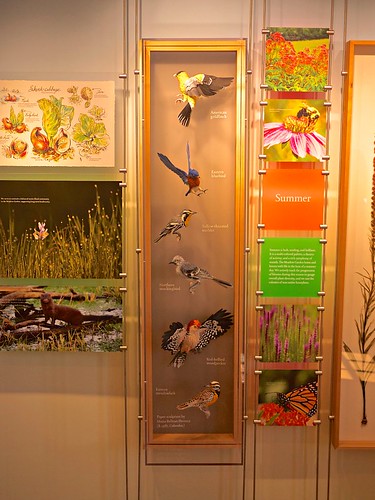
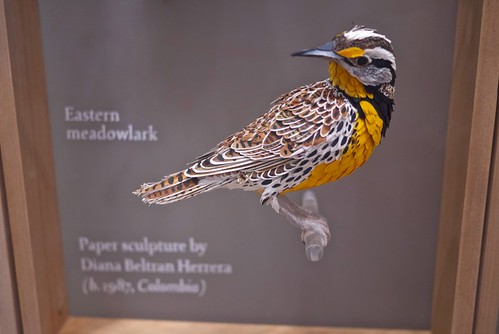
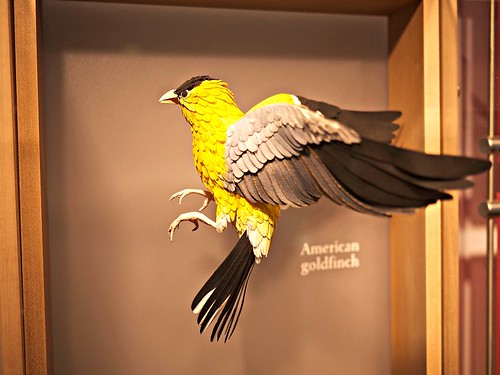
At Longwood Gardens, just up the road in nearby Kennett Square, Pennsylvania is Diana Beltran Herrera's paper birds that are on permanent display in the newly restored Webb Farmhouse & Galleries.


Paper sculpture birds by Diana Beltran Herrera

Diana was commissioned by Longwood and Gecko Group to create six sculptured representations that live in the meadow habitat where the farmhouse is located.

Paper sculpture birds by Diana Beltran Herrera

Golden painted edging glistens on the goldfinch's feathers.

Paper sculpture birds by Diana Beltran Herrera

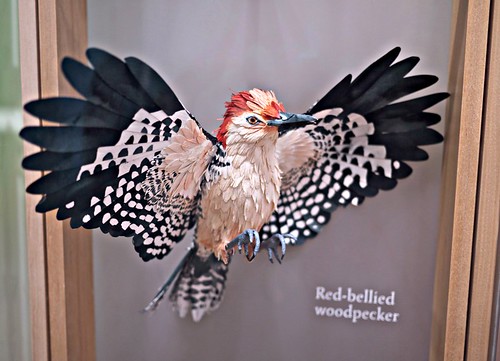
Many people stopped to look at the life-size birds, but I have a feeling casual observers didn't realize they are actually made of paper... the painted feathers, sharp beaks, and clawed feet are so realistic one might think he/she is looking at taxidermy specimens, although the paper sculptures are labeled as such at the bottom of the case.

Paper sculpture birds by Diana Beltran Herrera

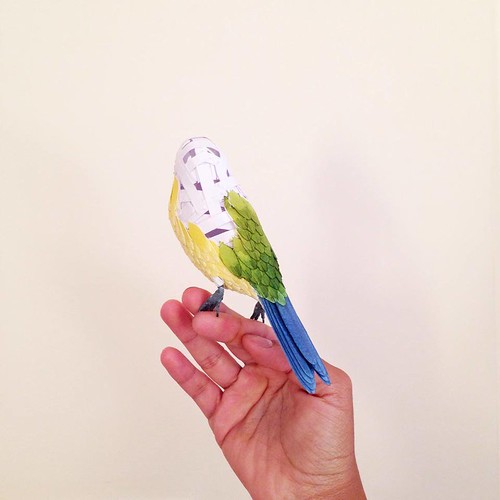
Not only are Diana's birds superb, but so are the photographs of each one that she posts on her website. Her ability to transform bits of painted and fringed Canson paper into three dimensional, life-like creations has been featured widely online. To give you an idea of the time Diana spends on each bird, a feature on Smithsonian mentions that the construction of a cardinal "might translate to just over six sheets of paper and five days of labor."

Paper sculpture birds by Diana Beltran Herrera
Photo: Thomas Poulsom

"An eagle or a crane, on the other hand, means 10 to 15 sheets of paper and up to two weeks of time. She observes some of the species in the wild, studies photographs of birds, and confers with ornithologists and birding groups to ensure an impressive level of visual accuracy."

Sunday, October 5, 2014

Mice and Chickens

Some people have problems with mice in their coop.  I have never had that probable except for one time when a half eaten one was found there.  I am not sure if they brought it in or whether it wandered in.  Either way, it met it's just fate.

Where I have had mice, and my happy little marmalade cat, Pascal,  killed both, was in the pantry where I store the grain.  The comment about sealing up the small openings is a definite must.  I had a large hole, that I found after the two were killed.  Caulk would not have solved that problem at all -- far too big.  So like those loarge holes in walls, I tried something similar.


 I cut a piece of cardboard to fit the size of the hole and rolled the SOS pad around until it was cylindrical and I attached it to the cardboard with hot glue.  I let that dry and then I used silicon caulk to attach the cardboard until the rug until I redo the floor boards and give a more permanent layering.

I can't get to the flooring now as we have a leaky roof above it, and while I have tried lots of methods to solve that problem, it still leaks.  I think it is things like that that make a person go mad, or sell the house... In the meantime, it leaks and only occasionally and sometimes less than that.

Both articles from LogCabin Homes, October 2014.


Pied Birds

You don't often hear this much.  You sometimes see this in old bird books, but to be honest, I haven't seen it in either the APA or the ABA standards but you will see plenty of "cuckoo".  That in fact is all the rage in StandardBreds these days...particularly Lemon Cuckoo.

• pied •

Pronunciation: paid Hear it!

Part of Speech: Adjective

Meaning: Mottled, having splotches of two or more colors, as 'a black and white pied magpie'.
Notes: Today's Good Word is known mostly for its use in "The Pied Piper of Hamelin". So, was his skin or hair splotchy? No, the name of this story is a reduction of the original name, "T

he Pied-coated Piper of Hamelin". This was a 17th century translation of the German story Rattenfänger "Rat Catcher", the main character of which wore a pied coat. Do not confuse this word with the pied in pied-à-terre "small second home". That pied is pronounced [pyed].


In Play: This word is used mostly to describe the mottled coats of animals: "My old pied hound points as well Fred's $800 thoroughbred hunting dog." Although it might just as well be used to describe clothing: "Maude Lynn Dresser came in a vicious pied overcoat that offended the tastes of the more modest attendees."


Word History:
Today's Good Word is an adjective from the Middle English noun pie "magpie", referring to the bird's black and white pied plumage. The earliest use was pyed freres, referring to an order of friars who wore black and white habits.

 English borrowed pie from Old French pie, the remnants of Latin pica "magpie", the feminine gender of picus "woodpecker". Latin took its word from the Proto-Indo-European root *(s)peik- "magpie, woodpecker", which came to Sanskrit as pikah "Indian cuckoo", and to German as Specht "woodpecker". 

Saturday, October 4, 2014

Rumpkin


Essays in Natural History
Chiefly Ornithology

 By Charles Waterton, Esq.


Published by Longman, Green, Longman, & Roberts, 1861
                        London,


The Rumpless Fowl
                Pauca me gallo...Vergil


A while ago I introduced the rumpless fowl to the readers of Mr. J. C. Loudon's Magazine of Natural History, to show them that there are birds who are just as brilliant and in such as good a condition as one which has no oil gland to preen himself.  This being true, I drew the conclusion that birds are not in the habit of anointing their plumage with the contents of the oil gland.

But whither the rump?

Buffon tells us in his natural history, that most of the hens and cocks of Virginia were rumples and that the inhabitants affirm that when tailed intermingle with the rumpless ones, they soon lose the rump.  Monsieur Fournier assured Count Buffon [Comte de Buffon} that when the rumpless one couples with an ordinary kind a half rumped sort is produced i.e. that it has six feathers in its tail instead of twelve; this Count Buffon relates is called the "Persian fowl".

Perhaps this is the case in eastern France?  So I investigated this chimera, and discovered that it is nothing more or less than the common barn door fowl and that it can be produced by a male and female, both furnished with a rump and a tail.

Two years ago, in the village of Walton, a common hen with a rump laid 18 eggs under a hedge.  There was not a rumpless fowl in all the village or the adjacent country.  The mowers were cutting the grass and the poor hen was killed by a stroke of the scythe and two little chicks were all that were saved.  One of the mowers brought them home and gave them to the lady that owned the hen and she brought them up, male and female both.  Amazingly, the male was rumpless and without a tail.  The female chick then hen was normal. 

When the rumpless cockerel was fully grown I introduced it to a rumpless hen, thinking that like should be with like.  This rumpless hen laid 14 eggs and sat upon them with great perservance; nothing happened.  Again during the course of the summer she tried again, and again the same result.  I felt sorry for her so I gave her a tailed mate and they become a loving duet.  She laid well the following summer, sat twice still nothing.

So it would appear from these experiments that the rumpless fowl is not prolific.  But as Cervantes tells us, one swallow does not a summer make so I tried again this time with a woman notorious for rearing poultry.  She has the knack, they say.  So I went to Nanny and asked her about this.  She said she had gotten a pair of rumpless chicks from the Isle of Wight and that they had reproduced and given her seven rumpless chickens but she could not get full price for them as many customers thought them strange so she did not pursue the endeavor as there was no money in it.
 

Count Buffon  {1707-1788}


Sod homes for grazing

I had a friend in Sussex County, New Jersey named Andy, who lived in one of these.  The man he bought it from was a real survivalist and wanted a geothermal home.  He built it literally into a mountain and then laid in water pipes that warmed the floors.  On top of his home, on the sod, he had a goat and a few chickens graze.    The man sold it to Andy because he had come up with some new designs for off the grid living and wanted to try them.


A yurt for your coop


Sounds expensive particularly at these prices, but to be honest these are rather high end yurts and you can get a basic yurt brand new for $5K but as you see above this is basically for human housing.  We don't want that, we are looking for another chicken coop and that is rather cheap, weather resistant and easy to install...Best of all, they are under $1G.   If you live in a milder climate than I do, you can get one for about $600.00. -- that's the same cost as a prefab coop.

Or you could put up the yurt just during the warm months or during construction of the "real coop".  Or course others just use a garage.

We thought of yurting the chickens but decided against it and went for the traditional wood structure.  I am not sure next time around we would make the same decision, and to be honest our smaller coops for particular chicks or hens is more like a covered conestoga.

Thursday, October 2, 2014

Hens and chicks from Deuteronomy

“If you are walking along, and spy  bird’s nest is lying on the ground, or if you see one in a tree, perhaps there will be young ones or eggs in it. 

Don’t take the mother with the young. Let her go, and only take  the young. The Lord will bless you for it.

Deuteronomy 2: 6-7